This article aims to provide practical advice for gifted and highly intelligent adults like Anna, who navigate life's complexities with exceptional cognitive abilities. We offer four key strategies to help these gifted and highly intelligent individuals not only excel in their careers but also cultivate meaningful personal connections and enjoy a fulfilling life outside of their intellectual pursuits.
Gifted and highly intelligent individuals often encounter unique social and emotional challenges. Consider the case of Anna, a 27-year-old software engineer known for her remarkable problem-solving skills and rapid learning ability. Despite her gifted and highly intelligent traits, she feels disconnected from her colleagues and misunderstood by friends, leading to a sense of isolation. This article aims to provide practical advice for gifted and highly intelligent adults like Anna, who navigate life's complexities with exceptional cognitive abilities. We offer four key strategies to help these gifted and highly intelligent individuals not only excel in their careers but also cultivate meaningful personal connections and enjoy a fulfilling life outside of their intellectual pursuits.
1) Recognise that Being Highly Intelligent is a Gift
We need to recognise that a high intelligence or IQ is inherently a gift, not a result of personal effort. In English, the term "gifted" officially refers to individuals whose IQ exceeds 130, placing them in the top three per cent of society in terms of cognitive ability (Lally & Valentine-French, 2019). This raises the question: is IQ determined by nature or nurture? Extensive psychological research has shown that genetics play a significant role in shaping our IQ, although our environment can slightly modify it.
In essence, possessing a high IQ is somewhat a gift from nature, not merely the fruit of our own efforts. It may not be something to take excessive pride in. For instance, learning a new skill through hard work can be a source of pride, but being gifted often isn't the result of personal effort—it's largely due to fortunate genetics. It's important to note that an official IQ test, conducted by a psychologist, is required to accurately measure intelligence. However, even without formal testing, most gifted and highly intelligent people can generally gauge whether they learn faster, at an average pace, or more slowly than others, which is likely influenced by their gifted nature.
2) Stay Humble and Embrace That Many People are Not Gifted
The second piece of advice for gifted and highly intelligent individuals is to recognize that you belong to a minority within the broader population. Highly intelligent people often learn quickly, yet they might struggle to find a compatible social group. This challenge arises because intelligence, including that of gifted individuals, follows a normal distribution, resembling a bell-shaped curve. Specifically, if your IQ is exceptionally high, over 130, you are considered gifted, placing you in the top three per cent of the population in terms of intelligence.
This statistical reality means that most people you interact with will likely have a lower IQ. However, being gifted or highly intelligent does not inherently make you a superior person. You should understand that while abstract concepts might be easily understandable to you, leading to interests or even passions in fields like philosophy or mathematics, the general public may not share the same enthusiasm or find the same success in these areas.
Gifted and highly intelligent individuals need to appreciate that differences in intellectual interests are merely variations in personal preferences. If you expect everyone to think like you because of your natural intellectual advantages, you might encounter significant social challenges.
3) Develop Diverse Skills Besides Intelligence
The third piece of advice is to cultivate skills beyond their intellectual prowess. This includes social skills, hobbies, and emotional management, which are vital for highly intelligent people. Psychologist Abraham Maslow famously said, "When all you have is a hammer, everything looks like a nail." (Maslow, 1966, p.15) This metaphor highlights that while high intelligence is a powerful tool for critical thinking a knowledge-based economy, it isn't suited for every situation.
Many gifted and highly intelligent individuals excel academically but may struggle with interpersonal communication, often focusing solely on intellectual topics. This tendency can lead to an imbalance, overshadowing other crucial life aspects such as building relationships and managing emotions. For highly intelligent people, the challenge is to recognize that their intellectual gifts, while significant, do not encompass all necessary life skills.
Gifted and highly intelligent individuals often need to be mindful of not letting their intellectual abilities dominate their personal growth. Learning to balance their cognitive strengths with emotional and social intelligence is essential, sometimes requiring painful experiences for true realization. This holistic development is crucial to lead fulfilling lives.
4) Make a Good Impact and Serve the Community
Gifted individuals and highly intelligent people are uniquely equipped to leverage their advanced cognitive skills for societal benefit. With their exceptional abilities in areas such as analytical thinking and problem-solving, these highly intelligent individuals are encouraged to direct their talents toward endeavours that positively impact the community. This approach not only allows them to fulfil their potential but also significantly contributes to societal progress.
Gifted and highly intelligent people are encouraged to actively seek roles in fields that not only challenge their intellect but also have a meaningful societal impact, such as advanced scientific research, financial investment, innovative technology development, or transformative policy-making. These areas not only satisfy the intellectual curiosity of highly intelligent individuals but also provide substantial opportunities to effect positive change on a broader scale.
By doing so, gifted and highly intelligent people not only maximize their capabilities but also serve as vital agents of change, using their exceptional skills not for personal elevation but as instruments for community enhancement and enrichment.
Download MindForest AI to Thrive as a Gifted and Highly Intelligent Individual
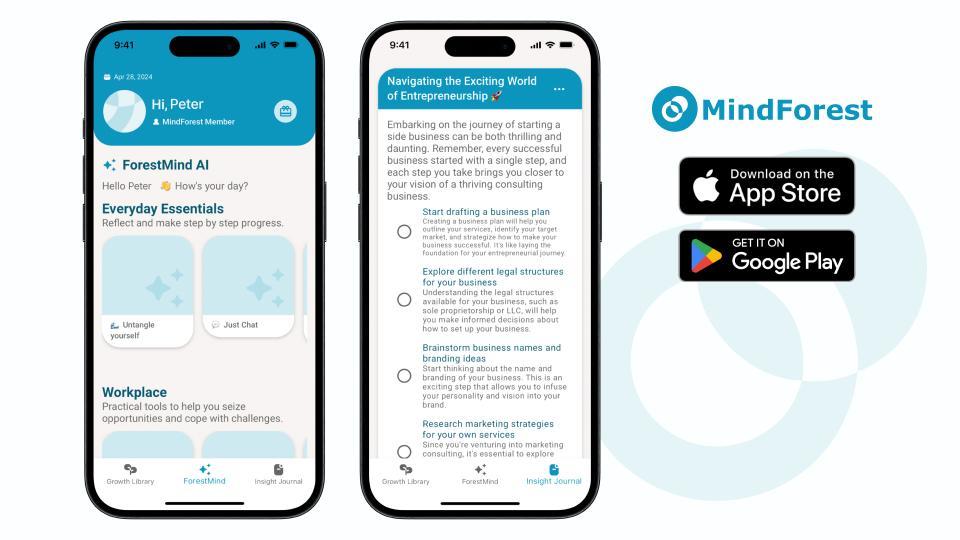
MindForest is an innovative AI app designed to support the unique challenges faced by gifted and highly intelligent individuals in their personal and professional growth.
1) Interactive Courses for Emotional Growth: Our courses enhance resilience and emotional intelligence, crucial for managing the intense emotions and social intricacies that gifted individuals often encounter. These courses offer practical exercises to improve emotional regulation and interpersonal skills.
2) Supportive AI Mentor: The app includes a supportive AI mentor tailored to the needs of highly intelligent users, offering personalized advice for leveraging talents, managing expectations, and balancing life's demands.
3) Reflective Insight Journal: This feature allows users to document their thoughts and experiences, enhancing self-awareness and helping to identify personal strengths and growth areas.
MindForest equips gifted and highly intelligent individuals with tools to navigate their unique challenges, fostering resilience and enabling them to thrive in all aspects of life. This comprehensive support system not only addresses immediate needs but also lays the groundwork for long-term success and fulfilment.
In conclusion, gifted and highly intelligent individuals are encouraged to fully embrace their remarkable abilities while maintaining humility. The journey may be marked by unique emotional and social challenges, but these can be effectively managed and overcome through consistent practice and self-reflection. It is important to remember that your gifts are not just for personal achievement but are also invaluable to the broader community. The world needs your insight and problem-solving skills to address complex challenges and drive progress. By staying grounded and using your talents to contribute positively, you can lead a fulfilling life that not only meets your own aspirations but also inspires and uplifts others. Embrace your gifts, commit to personal growth, and let your light shine brightly for the benefit of all.
References
Lally, M., & Valentine-French, S. (2019). Lifespan development: A psychological perspective. Lally, Martha and Valentine-Fench, Suzanne.
Maslow, A. (1966).The psychology of science. New York, NY: Harper and Row.
Psychology Insights & Life Applications
Discover practical psychology tips you can apply to your everyday life. From building resilience to improving relationships and finding work-life balance, our blog brings expert-backed insights that help you grow.
Early Dating Red Flags: 5 Warning Signs to Spot Before It Gets Serious
Dating can be exciting, but the early stages also reveal subtle warning signs that hint at future problems. Recognising these red flags can save emotional energy and help you make smarter decisions about who to invest in. In this article, we explore five key patterns that often emerge in early dating: ghosting and avoidant behaviour, nonchalant attitudes, commitment issues, performative male behaviour, and the “pick me girl” phenomenon. Each section breaks down the psychology behind these behaviours, explains why they happen, and offers insights to navigate modern dating more consciously and safely.
5 Reasons Causing Commitment Issue in Dating: What It Is, Why It’s So Common, and How to Navigate It
In modern dating, many people find themselves asking the same frustrating question: “Why does everything feel close, intense, and promising—until commitment comes up?” If you’ve ever dated someone who enjoys intimacy but avoids labels, long-term planning, or emotional responsibility, you may have encountered a commitment issue in dating. This phenomenon has become increasingly common, particularly in a culture shaped by dating apps, individualism, and emotional burnout.
This article explores what commitment issues in dating really mean, why they’re becoming more widespread, how to cope if you experience them yourself, and what to consider when dating someone who struggles with commitment.
Ghosting and Avoidant Behaviour: Why We Pull Away and 3 Ways to Heal from It
Have you ever experienced ghosting? The two of you were chatting happily the night before, and the next day the person suddenly disappears, never replying again?
Ready to Apply Psychology to Your Life?
Download MindForest and turn these insights into action. Get personalized support from ForestMind AI Coach, track your progress, and unlock your full potential.