Straightforward techniques and real-world applications to help you and your team tackle complex challenges with improved critical thinking and more effective decision-making.
Imagine you're in a team meeting, faced with a tough decision that could affect your company's future. This scenario is common in the workplace, where the ability to enhance critical thinking and improve decision-making is crucial. This article will explore simple yet effective psychological strategies to significantly boost these vital skills. By applying these approaches, you can better analyse situations, predict outcomes, and make decisions that are well-informed and aligned with your company's objectives. This article will provide straightforward techniques and real-world applications to help you and your team tackle complex challenges with improved critical thinking and more effective decision-making.
1) Avoid Confirmation Bias for Critical Thinking
In the professional world, enhancing critical thinking and decision-making is crucial. One way to improve these skills is by understanding and avoiding confirmation bias. This bias leads us to favour information that confirms our preexisting beliefs (Nickerson, 1998), thus impacting our decision-making negatively.
Consider a scenario where you must decide on implementing a new software system. If inclined to support this change, confirmation bias might make you only consider positive reviews and success stories, ignoring potential downsides. However, by actively seeking information that challenges your initial opinion, such as technical issues or inefficiencies reported by others, you ensure a more balanced and informed decision-making process.
This approach to critical thinking is also beneficial in everyday workplace interactions. For example, if a team member is underperforming, rather than focusing solely on missed deadlines or mistakes, try to uncover factors like external stressors that might explain these issues. This not only leads to fairer evaluations but also improves interpersonal relationships by fostering empathy and understanding.
Avoiding confirmation bias opens up new perspectives and information, leading to more balanced, fair, and well-informed decisions. This practice not only enhances critical thinking and decision-making but also contributes to a more inclusive and dynamic workplace environment. By learning about different cognitive bias, such as sunk cost fallacy, and considering diverse viewpoints, we can make better decisions and foster a culture of thoughtful inquiry and open-mindedness.
2) Establish a Diverse Social Circle for More Perspectives
Establishing a diverse social circle significantly enhances critical thinking and decision-making skills in the workplace. By interacting with individuals from various backgrounds and with different perspectives, we expose ourselves to a wealth of ideas that challenge our own, essential for sharpening our critical thinking.
Expanding our networks to include those with differing opinions is crucial. Similar to how a scholar engages in debates to refine their arguments, professionals benefit from discussing and defending their viewpoints with others. These interactions force us to articulate our thoughts clearly and defend our positions, revealing strengths and weaknesses in our reasoning. This process is analogous to a boxer training in the ring; intellectual confrontations test and improve our critical thinking skills.
Besides, engaging in discussions with a broad array of individuals often introduces us to reasoning and perspectives previously unconsidered, pushing us to reassess our views and enhance our arguments. By fostering an environment where ideas are openly challenged in a constructive manner, we avoid conflicts turning personal and create a space conducive to developing critical thinking.
Such a network not only bolsters our critical thinking but also improves our decision-making by providing a richer pool of knowledge and insights for our intelligence. This approach ensures that our decision-making processes are well-rounded and robust, having been vetted through diverse perspectives and rigorous debate, thereby enhancing overall workplace effectiveness.
3) Cultivate a Growth Mindset and Accept Criticism in Decision-Making
Developing a growth mindset and embracing criticism are crucial for enhancing critical thinking and decision-making in the workplace. Introduced by psychologist Carol Dweck, a growth mindset suggests that our abilities and achievements can be developed through effort, rather than being innate (Dweck, 2006). This perspective transforms criticism from a personal affront to a valuable tool for improvement, encouraging us to view feedback as an opportunity to enhance our skills and understanding.
For those with a growth mindset, criticism is not a reflection of immutable personal deficiencies but a prompt to refine reasoning and expand knowledge. This openness to feedback fosters continual reassessment of viewpoints and adaptability in thinking, which are essential for effective critical thinking and decision-making. It prevents complacency and drives us to question and improve our thought processes.
Even harsh or malicious criticism can be informative, prompting an examination of why certain ideas might provoke strong reactions and encouraging consideration of different perspectives. Ultimately, by adopting a growth mindset, professionals not only become more adept at handling criticism but also enhance their decision-making capabilities, leading to greater professional growth and wisdom. This approach ensures that decision-making processes are well-rounded and robust, having been vetted through diverse perspectives and rigorous debate.
Enhance Your Critical Thinking and Decision-Making with MindForest App
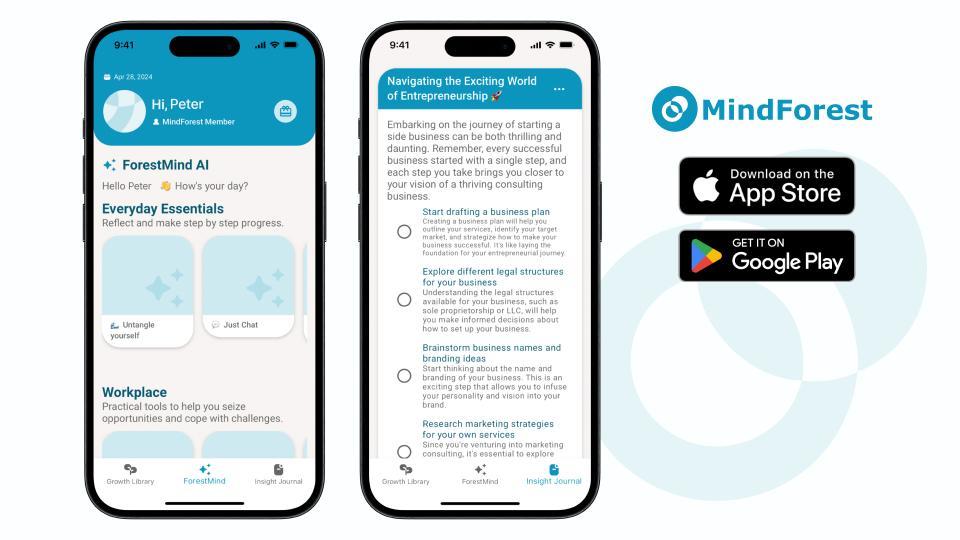
In today’s fast-paced business environment, critical thinking and decision-making are key to success, and MindForest is your digital partner in honing these essential skills. Discover how MindForest can transform your approach to problem-solving:
1) Structured Psychology Modules: MindForest offers interactive courses that introduce users to psychology concepts, enhancing understanding of human behaviour and thought processes. These modules apply psychological principles to real-world scenarios, improving your critical thinking and decision-making.
2) AI-Driven Scenario Analysis: Engage with an AI coach that not only supports you emotionally but also challenges your decision-making processes. These simulations provide practical experience in making tough decisions under various business conditions.
3) Insight Journal for Continuous Improvement: By analyzing your thoughts, MindForest generates detailed feedback. These encourage deep reflection on your decision-making patterns, helping you identify strengths and areas for improvement.
Download MindForest today to empower your journey in mastering critical thinking and decision-making, essential tools for navigating the complexities of modern business landscapes.
Unlocking Potential: The Critical Role of Critical Thinking and Decision-Making in the Workplace
In today's fast-paced business world, mastering critical thinking and decision-making skills isn't just an asset—it's a necessity. These skills empower employees to tackle complex challenges, swiftly navigate through decision-making processes, and minimise costly errors. More than just problem solvers, employees with sharpened thinking abilities are innovators and leaders who drive their organisations forward.
Using tools like the MindForest App, which provides structured learning, realistic scenarios, and actionable feedback, can significantly boost these skills. By investing in such advanced resources, businesses not only enhance individual performance but also ensure their adaptability and success in an ever-evolving market landscape.
Discover practical psychology tips you can apply to your everyday life. From building resilience to improving relationships and finding work-life balance, our blog brings expert-backed insights that help you grow.
Early Dating Red Flags: 5 Warning Signs to Spot Before It Gets Serious
Dating can be exciting, but the early stages also reveal subtle warning signs that hint at future problems. Recognising these red flags can save emotional energy and help you make smarter decisions about who to invest in. In this article, we explore five key patterns that often emerge in early dating: ghosting and avoidant behaviour, nonchalant attitudes, commitment issues, performative male behaviour, and the “pick me girl” phenomenon. Each section breaks down the psychology behind these behaviours, explains why they happen, and offers insights to navigate modern dating more consciously and safely.
5 Reasons Causing Commitment Issue in Dating: What It Is, Why It’s So Common, and How to Navigate It
In modern dating, many people find themselves asking the same frustrating question: “Why does everything feel close, intense, and promising—until commitment comes up?” If you’ve ever dated someone who enjoys intimacy but avoids labels, long-term planning, or emotional responsibility, you may have encountered a commitment issue in dating. This phenomenon has become increasingly common, particularly in a culture shaped by dating apps, individualism, and emotional burnout.
This article explores what commitment issues in dating really mean, why they’re becoming more widespread, how to cope if you experience them yourself, and what to consider when dating someone who struggles with commitment.
Ghosting and Avoidant Behaviour: Why We Pull Away and 3 Ways to Heal from It
Have you ever experienced ghosting? The two of you were chatting happily the night before, and the next day the person suddenly disappears, never replying again?
Ready to Apply Psychology to Your Life?
Download MindForest and turn these insights into action. Get personalized support from ForestMind AI Coach, track your progress, and unlock your full potential.